
The Serpent Column at the Istanbul Hippodrome: A Bronze Trophy of the Greeks That Has Endured for Two and a Half Millennia
Amid the marble dust of Sultanahmet Square, between the Blue Mosque and Hagia Sophia, a blackened bronze coil protrudes from the ground—three twisted serpent bodies without heads. This is the Serpent Column (Turk. Yılanlı Sütun, Gr. Τρικάρηνος Ὄφις), and it is older than almost everything around it. Before you stands the oldest surviving monument of classical antiquity in Istanbul, cast in 478 BCE from Persian weapons after the Battle of Plataea. The Serpent Column stood in Delphi for eight centuries, and in 324 AD, it was brought here by Constantine the Great to adorn the back of the Hippodrome of Constantinople. Since then, it has remained in place—but has lost some of its height, color, and magic.
History and Origin of the Serpent Column
The summer of 479 BC. At the foot of the Boeotian plain of Plataea, a combined force of thirty-one Greek city-states under the command of the Spartan regent Pausanias defeats the massive army of the Persian commander Mardonius. This was the battle that finally put an end to Xerxes’ second invasion of Greece: the Persian fleet had already been defeated at Salamis, and after Plataea and the parallel victory at Mycale, the great Achaemenid Empire would never again march on mainland Hellas. Herodotus describes how the victors gathered a vast amount of booty and dedicated a tenth of it to Apollo of Delphi.
From the captured Persian weapons, the Greeks cast a bronze column: three intertwined pythons rose upward, holding a golden tripod with a cauldron on their heads. According to one account, the casting was carried out at the Aegina bronze-casting school—in the 5th century BCE, the island of Aegina was renowned precisely for its bronze craftsmen. The monument stood next to the altar of the Temple of Apollo at Delphi, a few steps from the Sacred Way, and bore on its coils the names of the 31 participating city-states—from Lacedaemon and Athens to the small Euboean towns.
A scandal erupted immediately: Pausanias ordered a verse to be engraved on the tripod in which he named himself the victor—“Pausanias, commander-in-chief of the Hellenes, having defeated the Median army, dedicated this to Phoebus.” Upon learning of this, the Spartan ephors ordered the inscription to be erased and the allied cities inscribed in its place; later, as Diodorus Siculus recounts, a couplet by the poet Simonides appeared on the column: “The saviors of Greece erected this, having freed the cities from shameful slavery.” Pausanias himself, suspected of negotiating with the Persians, met a grim end—he was walled up in the temple of Athena Medonome. Pseudo-Demosthenes, in his speech “Against Neera,” even claims that the enraged Greeks, through the Amphictyonic Council, demanded a fine of a thousand talents from the Lacedaemonians — and it was precisely this grievance, according to the orator, that half a century later prompted the Spartans to support the night attack on Plataea in 431 BCE, which marked the beginning of the Peloponnesian War.
The monument is mentioned by virtually all major Greek and Roman authors: Herodotus, Thucydides, Pseudo-Demosthenes, Cornelius Nepos, Plutarch, and Diodorus Siculus. In the 2nd century CE, the traveler Pausanias (a namesake of the Spartan) personally saw the column in Delphi and described it in his *Description of Greece*—already without the golden cauldron, which by that time had been lost. The golden cauldron had been torn down as early as 354 BCE by the Phocians during the Third Sacred War to pay off mercenaries. This sacrilege cost the Phocians their expulsion from the Amphictyonic League and a fine of 400 talents. The bronze body was not damaged during the remelting—and in 324 CE, by order of Constantine the Great, it was transported to the new capital of the Roman Empire and installed on the back (central axis) of the Hippodrome between the Obelisk of Theodosius and the Colossus, so that the city, which according to legend suffered from an invasion of snakes, would be protected by the ancient talisman.
Architecture and What to See
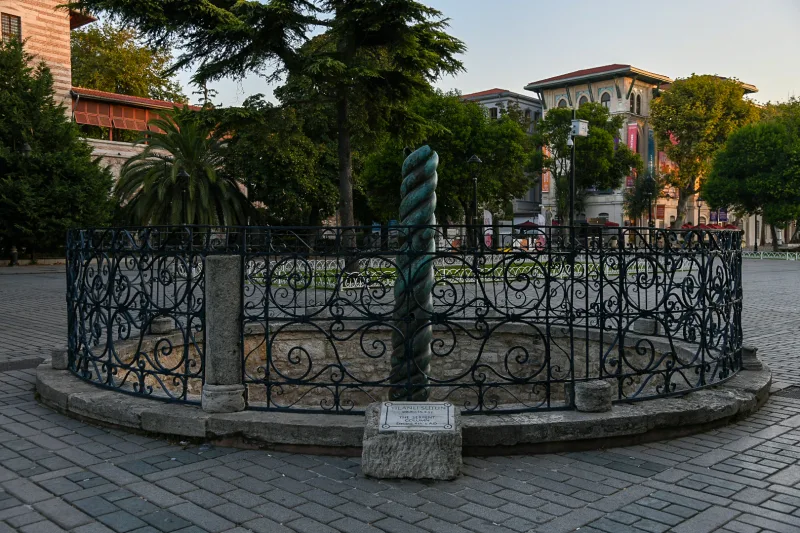
At first glance, the Serpent Column is disappointing: a dark stump about five meters high sticking out of a pit, surrounded by a cast-iron railing. But if you linger, details begin to emerge that make the trip worthwhile.
What remains of the column
Originally, the monument stood 8 meters tall, including the golden tripod. Today, only the bronze coil remains—5 meters long, with 29 surviving coils. The column stands in a depression about one and a half meters below the modern level of the square: the ground level above the Hippodrome was raised as early as 1630, and in 1855–1856, the English archaeologist Charles Thomas Newton unearthed the lower fifteen coils. Technically, what we have here is a solid, hollow bronze barrel cast using the single-melting technique—a feat of the highest order for the 5th century BCE.
Inscription 31 of the polis
The most interesting part is the section of the bronze facing northeast, toward the Blue Mosque. Here, between the third and thirteenth coils, is the Laconic inscription “Those who fought the war,” and below it, in a column, are the names of 31 Hellenic city-states that participated not only in the Battle of Plataea but also in all the Persian Wars. This is one of the oldest known Greek inscriptions to have survived in its original form. Herodotus does not mention eight of the city-states on this list in his Book IX, while Pales of Cephalonia, which appears in Herodotus, is absent from the column—discrepancies that historians still debate today. The texts were deciphered in 1856 by K. Frick, and in 1886 Ernst Fabricius published the canonical reading.
The Preserved Snake Head
The most beautiful part of the column is not in situ but in the Istanbul Archaeological Museum, in the “Istanbul Through the Centuries” hall. It is the upper jaw and part of the skull of one of the three serpents: large triangular teeth, deeply carved eyes, and a powerful lower jawbone. The head was discovered in 1848 by the Italian architect Gaspare Fossati, the very same man who restored Hagia Sophia under Abdul-Mejid. It’s literally a ten-minute walk from the column to the museum through Gülhane Park; to understand the Serpent Column and its original appearance, this small fragment is more important than the bronze statue itself in the square.
Context: The Back of the Hippodrome
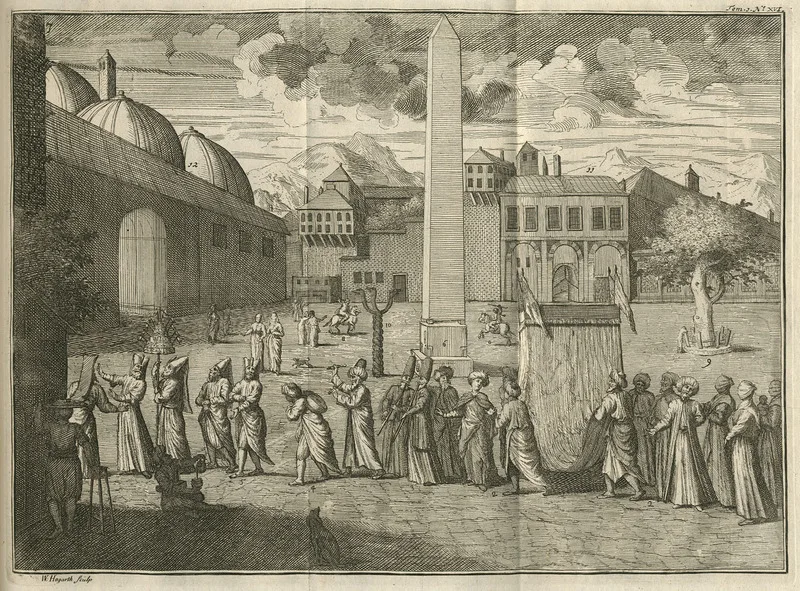
The column is just one of three surviving monuments from the ancient back of the Hippodrome. Nearby stands the Egyptian Obelisk of Theodosius, brought from Karnak in 390, and slightly further south—the Walled-Up Obelisk (Colossus), likely built during the reign of Constantine VII. Together, they form the axis along which quadrigas once raced, and without which it is impossible to understand the urban layout of the Byzantine center. According to the excavations of Stanley Casson, conducted in 1927 on behalf of the British Academy, the bronze shaft was not installed here immediately under Constantine, but was likely relocated in the 9th century, when the landscaping of the area was completed during the Middle Byzantine period. Engravings have survived—for example, a drawing by Aubry de La Motte from 1727, in which the column is still shown with two of the three serpent heads—and these images allow archaeologists to reconstruct the monument’s original appearance much more accurately than the surviving bronze itself.
Interesting Facts and Legends
- In medieval Constantinople, the column was considered a talisman: as long as the snakes remained intact, snakes, scorpions, and centipedes would not crawl into the city. The Ottomans repeated the same legend. Evliya Çelebi wrote that after the first head was lost, scorpions and centipedes allegedly immediately multiplied in Istanbul.
- Who struck off the snakes’ heads is a mystery. According to one account, Mehmed II the Conqueror, upon entering conquered Constantinople, struck the snake with an iron mace in a burst of strength and knocked off its lower jaw. Other chronicles attribute the act to Selim II, Suleiman II, or Murad IV. A third version blames the drunken Polish ambassador Leszczyński, whose nerves gave out on the night of October 20, 1700.
- The most prosaic and, apparently, accurate version comes from the Ottoman historian Silahdar Findikli Mehmed Aga: his *Nusretname* states that the three serpent heads simply fell off on the night of October 20, 1700. Most likely, the cause was centuries of wear and tear on the bronze.
- In the 12th–13th centuries, the column was converted into a fountain: water flowed from the mouths of the three serpents. Perhaps it was precisely this utilitarian function that saved the monument from being melted down by the Latins in 1204.
- In 2015, a bronze replica of the Serpent Column was installed at the archaeological site in Delphi—in the very spot where the monument had stood for nearly eight centuries. The replica was cast from a plaster mold that has been kept at the Delphi Museum since 1980.
How to get there
The Serpent Column stands on Sultanahmet Square (formerly the Hippodrome, Turkish: At Meydanı) in the historic Fatih district, right in the heart of old Istanbul. Coordinates: 41.00562, 28.97512. It’s easy to find: between the Blue Mosque and the Obelisk of Theodosius, in a small recess behind a cast-iron grille.
The most convenient way to get there is by the T1 tram, Sultanahmet stop. It’s a 200-meter walk from the stop to the column. The T1 line connects Sultanahmet with Eminönü, Karaköy, Kabataş, and Zeytinburnu, covering all key routes through the Old City. From Istanbul Airport (IST) — take the M11 metro to Kâğıthane, then transfer to the M7 and switch to the T1 (about 1 hour 20 minutes). From Sabiha Gökçen Airport (SAW) — take the Havabus to Taksim and transfer to the tram via Kabataş.
The square is open 24 hours a day, and access to the column is free—it is one of the few ancient monuments in Istanbul that can be viewed at any time of day without a ticket. The nearest paid parking lot is near the Archaeological Museums on Alemdar Street.
Tips for travelers
The best time to visit is early morning (before 9 :00) or late evening after sunset, when there are the fewest tourists and the slanting light beautifully highlights the texture of the ancient bronze. Spring and fall are the most comfortable times to visit Sultanahmet: in summer, the marble gets scorching hot, and in winter, there are frequent rains and strong winds from the Bosphorus.
Allow 15–20 minutes for the monument itself—it doesn’t require more—but be sure to combine it with its two neighbors: the Obelisk of Theodosius (a 5-minute walk) and the Column of Constantine. Together, these three sites provide a complete picture of the Hippodrome’s back side. After that, a ten-minute walk will take you to the Istanbul Archaeological Museum—and for the sake of the preserved serpent’s head, it’s worth visiting there right after the column so you can mentally reconstruct the monument to its original appearance.
Important information for Russian-speaking travelers. The Column is located within the T1 tram zone and a 5-minute walk from the city’s two main mosques; dress appropriately so you can enter both the Blue Mosque and Hagia Sophia (shoulders and knees covered; women must wear a headscarf, provided free of charge). Pickpockets are active in Sultanahmet—wear your backpack in front. For photographers, the best vantage points are the northeast edge of the fence (where the inscription with the names of the cities is visible) and the south side (where the silhouette of three intertwined snakes can be seen against the backdrop of the Blue Mosque). And remember: The Serpent Column is not just a bronze structure in a pit, but the only direct witness in Istanbul to the Greco-Persian Wars, a tangible fragment of the very era in which Herodotus wrote his “History.”